Talking With Monuments: Some Monuments Are Beneath Our Feet
Updated: Jul 4
Field notes from a week between the Smithsonian and Milwaukee

Talking With Monuments at the Milwaukee County War Memorial Center
In 2023, while working in Milwaukee with veterans and medical anthropologist Dr. Katinka Hooyer, I photographed a burial mound marker in the city. The bronze plaque identified the site as a prehistoric burial mound and noted that it was the last of a larger group of mounds formerly located there.
By the time I returned to Milwaukee in June 2026, the plaque was no longer in place. I don’t yet know whether it had been removed for conservation, replacement, or another reason. It’s also possible that the older language on the plaque, including the word “prehistoric,” is being reconsidered.
Whatever the reason for its absence, the missing marker stayed with me. It made me think about another layer in a longer story of erasure: not only the loss of many mounds themselves, but also the disappearance, revision, or replacement of the markers that once named them. A place can be sacred and still look ordinary to someone passing by. A history can be present and still remain unseen. A marker can tell us where to look, and then the marker itself can vanish.
I’ve been thinking about that missing plaque alongside the events of this past week, which carried me between Washington, D.C. and Milwaukee, between the Smithsonian National Museum of African Art and the Milwaukee County War Memorial Center, between museum space and veteran testimony, between public visibility and quieter acts of witnessing.

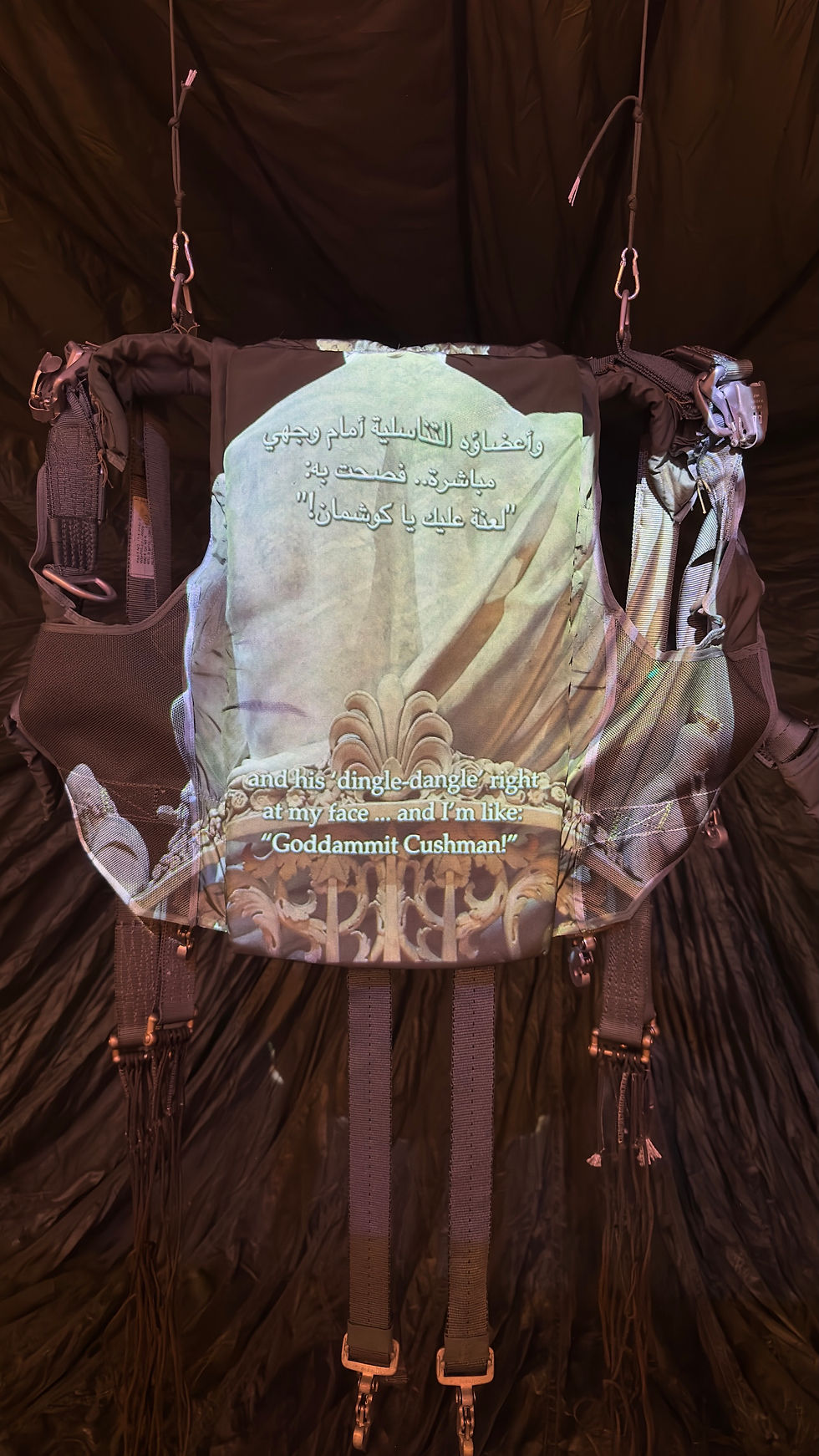
I began the week in Washington, D.C., where I took part in the artist panel for Here: Pride and Belonging in African Art at the Smithsonian National Museum of African Art. My work Untethered/Retethered is included in the exhibition.
The installation is made from a decommissioned military parachute, severed suspension lines, a detached harness, video, and audio built around the recorded voices of military veterans. The work brings military material into close proximity with voices, bodies, memory, and the difficulty of returning to civilian life.
At the panel, I spoke briefly about the work’s material presence and the long process of developing it with veterans. I also spoke about how strange it can feel to work with something visually beautiful that comes from a military context. It’s my hope that viewers can sit with the parachute, the severed lines, the harness, and the voices in their own way.
Below is a selection of images from the artist panel and opening programme for Here: Pride and Belonging in African Art at the Smithsonian National Museum of African Art, Washington, D.C., 2026. Photography by Studio Ari.
A few days later, I travelled to Milwaukee for the final session of Talking With Monuments: Veteran Dialogues on Remembering, a project developed with Dr. Katinka Hooyer and veteran participants through the Medical College of Wisconsin. The session was held on Thursday, June 25, 2026 at the Milwaukee County War Memorial Center.
The move from the Smithsonian to Milwaukee felt important to me. In DC, the work was being held within an exhibition. In Milwaukee, some of the questions that had shaped the work were being carried into a room with veterans, facilitators, and members of the public.

Katinka introduced me at the beginning of the session, and I gave a brief introduction to myself, my work, and the exhibition I’m part of. But once the session began, I mostly just listened.
That felt right. As a South African artist and a non-American visitor in that room, I didn’t feel I needed to speak more. I’d helped shape the guide for the session with Katinka, but the conversation belonged to the people gathered there: veterans, civilians, facilitators, and people carrying their own relationships to service, land, memory, and loss. I think that sometimes presence is enough. Somehow witnessing seemed the more honest role.
This final discussion group focused on Native American burial mounds in and around Milwaukee. Marquette University historian Dr. Bryan C. Rindfleisch opened the session with an overview of the mounds and their historical context. The guide Katinka and I created asked participants to consider a deceptively simple question: are these mounds monuments?
We often think of monuments as things that stand upright in public space: statues, plaques, columns, war memorials, civic markers. They tell us where to look. They often tell us whose names have been made visible. Mounds however, ask for a different kind of attention. They don’t dominate the landscape in quite the same way. They belong to it. They’re made of earth and many are burial or ceremonial places. They hold memory without necessarily announcing themselves in the familiar language of bronze or stone.
So what happens when a monument isn’t above us, but beneath our feet?

The discussion moved quickly beyond history alone. Participants spoke about land, removal, military service, American imperialism, immigration, moral injury, and the stories nations tell about belonging. Veterans spoke with striking honesty about serving in other countries and later questioning why they’d been sent there at all. Some of the questions in the room were difficult to hear: What were they protecting? Whose land were they standing on? Which histories had they been taught to see? Which ones had remained outside the frame?
These questions didn’t resolve into a single position. They moved around the room and sat uneasily beside service, loyalty, harm, responsibility, grief, and moral injury.

One participant spoke movingly about growing up on reservations, and about the stark differences between the facilities available to Native children’s schools and white schools. That testimony shifted the room and brought with it the question about land back to lived experience: childhood, schooling, infrastructure, neglect, and survival.
In the guide, the Milwaukee mounds were paired with Louise Erdrich’s poem Indian Boarding School: The Runaways. I remember selecting that poem and hearing it read again in that room, among veterans, civilians, and people carrying different relationships to land, return, and displacement, I cried. Other people cried too.
I think I cried because of the difficulties so many of us are experiencing in the political and social environment we find ourselves in now, in 2026. The poem also made me think of my own family, and of the silences I carry in me. I felt the swirling resonances between apartheid South Africa and the current moment in the United States. And I cried because it’s so difficult to speak about these things at all, when silence so often remains the obvious choice.
Hearing that poem in that room brought the mound into contact with children, removal, return, punishment, longing, and the question of who gets to decide where a person belongs. At points, the discussion moved into current debates around immigrants and immigration policy. That shift made sense to me because once a room begins to speak honestly about land, removal, borders, belonging, and state power, the conversation rarely stays neatly contained. Native land and immigrant lives aren’t the same story, but I found myself wondering how both become caught in public arguments over who is allowed to belong and who gets to claim the authority of “home.”
That felt especially important inside a war memorial. The Milwaukee County War Memorial Center is already a place shaped by remembrance, service, and public mourning. Holding a conversation about Native American mounds there brought different forms of memory into the same room: military memory, Indigenous memory, civic memory, personal memory. They didn’t sit comfortably together and perhaps they shouldn’t.

I left Milwaukee grateful, but also uncertain. The future of this work isn’t guaranteed. Funding is fragile. Humanities programs are under pressure and veteran-led public memory projects often depend on people continuing to hold open spaces that institutions may not sustain.
I don’t know what happens next, but I know what happened in that room was important.

At the end of the session, Dan, one of the veterans featured in Untethered/Retethered, gave me a DC Superman comic book, joking to the room that its gloriously homoerotic cover made it the perfect gift for me. Of course, I clutched it to my chest with my usual camp reverence! I was also able to give him copy of the Here: Pride and Belonging in African Art exhibition book. For me, it was a funny, absurd, generous, and unexpectedly tender moment.

I’ve been thinking about that exchange alongside the removed bronze plaque in Milwaukee. One object disappeared from the landscape. Another object passed from hand to hand. A marker was removed. A book was given. A comic book became a joke, a gift, and a form of recognition. A poem opened a room. A group of people sat together and listened.
Some monuments stand above us. Others are beneath our feet. And some forms of memory survive because people carry them, however briefly, from one room to another.